| Animation: | Fair |
|---|---|
| Depth: | Fair |
| Design: | Fair |
| Characters: | Fair |
| Story: | Fair |
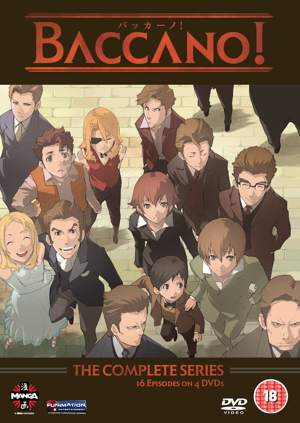
Type: TV (16 episodes)
Vintage: 2007
Category:
 Reviews @ Archen's Anime Page

Baccano
Summary: >
America in the 1930s was a period marked by violence. Some people thrive in this environment, and are often associated with the mob. Stranger than these people are those who don't fear death not because they are untouchable, but because they cannot die.
Thoughts: >
Baccano attempts many interesting ideas but only does a mediocre job with them. It's not bad but it falls short. It runs into trouble with both it's characters method of storytelling. Many people fawn over this series, so I suppose you can take my opinion with a grain of salt, but I don't think it's anywhere near as good as many make it out to be.
Baccano has three different stories (and one oddball episode) taking place at different times. Baccano then flips back and forth between them. This could work except there are too many characters and most aren't present in the other stories. This makes each story disjointed and sometimes difficult to pair which character goes with which story, figure out who's important, and even remember the context of what was happening. More puzzling still is that the strength of this formula is completely missed by Baccano: at some point the stories should intersect and tie them together. Instead they're just told at the same time. Two of the three don't really accomplished anything and only the train heist is compelling. What might be filler in many titles is inserted but cleverly camouflaged.
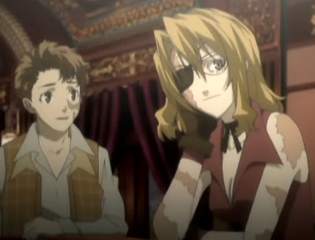
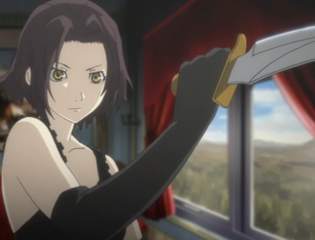
Out of the 20 or so characters, I only liked two of them. Eve, who is a little girl and part of a mob family looking for her brother. She's a sheltered rich girl with an temperament you never see in anime but very appropriate for the 1930s setting. There is also "the woman in the black dress" who is in the background most of the time, but becomes prominent later on and her part evolves into an interesting noire piece.
Conversely there is a very long list of characters I actually hated. I won't get into all of them, but there are a lot people who enjoy killing - particularly the guy who's often talking to his girlfriend about how he would like to kill her. I'm like: "Uh, is that a joke?". Some characters go into long winded speeches about killing as well. It's mostly drivel aside from one guy who's philosophy is that he's the only person that really exists (that kind of works).
Baccano revels in violence but the shock value wears off quickly, making it a gimmick. I couldn't distinguish between mortals and immortals so I assumed everyone was immortal. It's like a true manifestation of plot armor, where the main characters actually can't die. The immortality thing wasn't even necessary, it's just a device to allow for more violence. Which is a plus if that's your thing I guess.
The 1930s environment is a rare treat, particularly with the swing music soundtrack. If you watch mob movies for the gun battles this would be the perfect anime for you. The dub does a surprisingly good job fitting the period with quirky accents and old style lingo. It's hit and miss, but I liked it. It was fun listening to some voice actors I'm familiar with trying something different.
Substance wise I think Baccano is weak but based on the merits of environment and style it scores pretty well. It may have worked better with many characters and maybe splitting up the story but not both at once. Baccano isn't as clever as it thinks it is, but it's a reasonable watch considering the less common environment.
Quote: >
Firo: Stop. I'm not that smart! Use smaller words.
Screen Caps: >