Anime is an inherently Japanese thing with culture being a baked in feature; a part of what makes it so much fun. Some cultural aspects seem puzzling, so I thought I'd make a short page discussing a few of them.
Japanese use collective nouns, that is; there are no singular or plural forms. Saying "my favorite animes" is wrong. Anime, manga, and otaku are collective words (like moose). As a non English word used in English there really aren't rules governing it, so this isn't strictly true. Maybe you can like "animes" and while your at it go chase some mooses.
Useful Vocabulary
- otaku
- In an anime context this means something like "crazy about anime" but is akin to being a geek in Japan. "Otaku" refers to geeky obsessive behavior, with many different types such as anime, train, military and pop-idol otaku just to name a few. This has a negative connotation, but attitudes are lightening towards otaku, much like being a geek isn't as bad as it used to be in America.
- moe
- Moe and some other terms like Tsundere have their own article (here) if you're interested.
| bishonen | pretty boy |
|---|---|
| doujinshi | manga by amateur artists (often adult in nature) |
| eyecatch | animation sequence before/after commercial break |
| manga | Japanese comic books |
| mecha | advanced large machines (ex. giant robots) |
| nyan | meow |
| OAV | Original Animated Video (same as OVA) |
| OST | Original Sound Track |
| seiyuu | voice actor or actress. Fairly prestigious in Japan |
| senpai | upperclassmen / senior associate |
| shounen | manga oriented to teenage boys |
| shoujo | manga oriented to teenage girls |
| yaoi / BL | male + male relations (boy love) |
| yuri | girl + girl relations |
School Uniforms
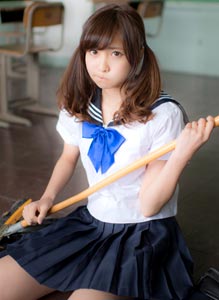
A well known striking feature of anime; school uniforms have in use in Japan since the 1800's. Before World War II, all students wore uniforms. Currently this isn't mandatory, but the majority of schools still require them. One type often seen in anime is the sailor style uniform; considered by many to be what a school uniform should look like, and fancied for its nostalgic value. Some say these are descended from Meji era uniforms, others believe they're a take on Victorian England school uniforms. This style is losing popularity in modern times, and might be rare to see. Modern uniform styles have much more variation to help strengthen school identity, and look a bit more stylish. The most common years to require uniforms are junior high, and high school, although some 2 year colleges use them too!
Are the skirts really that short? Depends on what anime you're referring to. They aren't so short they lack modesty (in anime they are sometimes this short), but they can come a fair bit above the knee. Some girls wear knee socks, and most variations seen in anime are actual fashions. Skirts are conspicuously longer (to the ankles) in anime when portraying delinquents known as sukeban (lit. "boss girl"). More commonly referred to as yanki these days. Girl gangs have a long history in Japan, and can be quite vicious. The image of the sukeban was solidified by a show called Sukeban Deka in the 80s (based off a manga). Anime still pays homage to this series by often showing a sukeban using a yo-yo (weapon of choice by the female lead in the show).
Blood types
Blood types are often listed in person/character profiles. In Japan blood type is thought to reflect personality traits. While this isn't taken too seriously, it occasionally crops up in odd ways. For instance, in 2011 a Japanese public official resigned after making insensitive comments. He noted his blood type was B and he was prone to being irritable and impetuous.
- Type A
- Good: Obedient, Empathetic, Self-Sacrificing, Polite, Honest, Loyal
- Bad: Emotional, Indecisive, Introverted, Anti-Social, Nervous
- Type B
- Good: Cheerful, Outgoing, Optimistic, Adventurous, Sensitive, Kind
- Bad: Forgetful, Undecided, Disorganized, Noisy, Spontaneous
- Type AB
- Good: Sensitive, Proud, Discriminating, Easy-Going, Sympathetic
- Bad: Short-Tempered, Complains, Dependent, Moody, Brooding
- Type O
- Good: Confident, Strong-Willed, Judgmental, Dedicated
- Bad: Workaholic, Insecure, Emotional, Stubborn, Cold Personality
The Kimono
Kimono literally means "thing to wear", but refers to the more traditional form of silk clothing in Japan. The Kimono changed throughout Japanese history, with the style most are familiar with dating from the Edo Period (1601-1867). After this Japan underwent industrialization and adopted the western style of dress, but never fully abandoned the Kimono. A similar form of traditional outfit is known as a Yukata: a less expensive garment made of cotton. During summer festivals it is more common to see a yukata. A kimono is distinguished by the silk fabric, two or more collars, and requires special shoes. Traditional Japanese weddings still use them, with the bride wearing a pure white kimono known as a shiromuku. Western weddings (and attire) are common too. Some couples opt for both provided they have the money. The proper way to clean a kimono is to undo all the stitching before washing, and sew it back together afterwords.
High Pitched Voices
In Japan high pitched voices are considered cute and to some extent more feminine.
Anime often featuring younger cute girls leads to a very squeaky sounding cast.
I was once told High pitch is cute, higher pitch is cuter, and the Tokyo girl
is so cute, her voice can almost shatter glass.
Some companies instruct female
receptionists to use a higher voice when dealing with customers. This kind of image
is still held in high regard, with some classy department stores paying attractive
women to work the elevator and announce the floor.
Shishi-Odoshi
If you're acquainted with anime, you've likely seen this device made of bamboo which periodically makes a "thunk". This is known as a Shishi Odoshi, or literally "deer scarer". The original intent was similar to a scarecrow: scaring away animals who might plunder a garden but there isn't much info on how effective it ever was. Over time this became an interesting feature commonly used in gardens where flowing water was available. In anime this is often used to highlight a sense of tradition around an older styled Japanese household.
Love & Relationships
Miai (or Omiai) is a semi formal occasion where two singles are introduced to each other with intent that they should consider marriage. In anime, very strict upper class families are depicted using this to facilitate arranged marriages. More commonly, it is a kind of match making service. In a Miai meeting, each single and their respective party (often but not necessarily family) sit opposing each other, commonly over a table for dinner. Typically a person known as a Nakodo facilitates the process. Miai provides a formal way to introduce people, while avoiding much of the awkwardness of a first date - especially if the two don't hit it off. It's certainly a godsend for shy people! It's not free-for-all dating, nor arranged marriage. Miai offers a happy medium, which is probably why it's still fairly popular.
Also in the topic of love, the Love Hotel is an often misunderstood part of Japanese culture. In the west a "pay by the hour" hotel is considered a seedy place, but the Japanese view them as offering a needed service. Japanese houses traditionally had paper thin walls since they were literally made of paper. With other family members present (children, elderly parents etc) there is virtually no privacy. While often gaudy compared to regular hotels, they are very clean and even somewhat romantic. More elaborate options are offered by some establishments for customers with "exotic" needs. Despite being a massive industry with billions of yen in revenue, there are no love hotel chains. Most have a single owner, and it's rare for more than a few to be run/owned by the same person. Love hotels are often congregated in a district. Since the hotels only have one purpose, there's obvious implications taking a date in that direction. Due to the fact that they are available 24 hours a day, and often have an automated check-in, they can be the only option during very late hours when public transportation stops. Yeah, just keep telling your date that!
In married life, the man is traditionally the head of the houshold in Japan, but couldn't be bothered with mundane things like money, leaving the woman to manage finances - including giving her husband an allowance even though he's the one earning the money. This leads to the stereotype housewife who is exceptionally shewed with money, and obsessed with good deals. The Japanese are very pragmatic if there is no son to inherit the family. In high standing families, a lower status man may marry into the family and take the wife's surname. This is known as mukyoshi. In this situation the man may have less authority in a family as an adopted member. The imperial throne had an issue over succession with no boy (until 2006), so why wasn't mukyoshi considered for this situation? In fact Japan has had female emperors before, but the United States wrote the Japanese constitution after WWII in such a way where only males can inherit the throne.
Holidays
- New Years is the most important holiday in Japan. Shrines become a popular place to congregate to welcome the new year.
- Christmas is the big dating holiday of the year. Gifts are often exchanged on a date. Chicken has become a popular Christmas meal, with KFC being the common choice.
- Valentine's Day is only associated with women giving men chocolates. Chocolate giving varies between "duty chocolate" to the more sincere "true love chocolates" (often hand made).
- Formerly Valentine's day giving was one way (female to male), Now men are expected to reciprocate those gifts on White Day (March 14th).
- Golden Week refers to a week with many holidays crammed together. With so many Japanese traveling, transportation bogs down and many businesses are closed - making this a terrible time for tourists. One odd holiday among these is the (former) Emperor's Birthday (now called Green Day). Most don't consider this a big deal but welcome any excuse for a another much needed day off.
Odds & Ends
- Rock-Paper-Scissors originated in China and is known in Japan as Jan-Ken-Pon. It's still very popular.
- String of Fate - It is said two people who are destined to be lovers are connected by a red string (typically tied around the pinky finger) which cannot be broken. Variations of this idea in anime connect many people through threads or a similar binding force
- Thieving Cat - is an idiom more often heard in soap operas, but occasionally crops up in anime. It's refers to a woman who has an affair with a married man.
- Sneezing in Japanese folklore indicates someone is talking about you.
- 4 and 9 are considered unlucky numbers in Japan. 4 is pronounced shi which can mean death, and 9 can be pronounced ku also meaning suffering. Both numbers have alternate pronunciations (yon and kyuu). Sometimes these numbers are absent in street addresses, apartment numbers and even building floors.
- Driving is done on the left side of the road in Japan. It is one of the few countries never under British rule that does so. On rare occasions, anime scenes taking place in America may have backwards signs. Japanese animators may draw cars on the left, only catching the mistake later. The cheap fix is to mirror the scene.
That's all I have to say about Japanese culture. I hope you learned something new and interesting!