A brief introduction
So what is anime? It's common in Japanese to truncate words, so "animation" became "anime". This word was adopted to refer specifically to Japanese animation in the west. Many years ago, one of the first western distributors referred to anime as Japanimation, although this quickly fell into disuse. Although only recently popular in the west, anime has a fair amount of history behind it.
Where did anime come from? In the beginning there was the cave picture etched in stone... A few thousand years later, motion pictures were invented. Motion pictures were mostly concerned with true life depictions, however the roots of animation also go back to the beginning of film. While film has advanced in many ways, some of the painstaking methods first used in animation are still used in anime today; although modernized, and far less labor intensive. Looking at early animation of the 30's, some shows of Betty Boop and Felix the Cat have very anime like features.
The beginnings of modern anime took shape around the 1960's. By the 1980's, anime was its own thing: a distinct media separate from other forms of animation. By late 1999 raw (paper) animation cells were no longer produced, with today's anime created with computers. More realistic CGI animation had been ongoing for quite some time, so questions arose about anime becoming something new. Instead modern anime stayed true to the style it was known for.
Characteristics of Anime
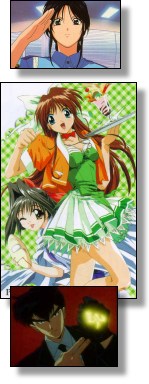
There are many physical features associated with anime, but best known are the large eyes. Ironically this feature of Japanese anime makes all the characters look anything BUT Japanese. The Japanese seem to prefer this style (and cute things in general really), which is cited as a reason why western titles are often not well received in Japan. Eyes in earlier periods (70s) didn't really have exaggerated eyes at all; not far removed from their size in western animation anyway. Over time the exaggeration became more pronounced, and ingrained itself as one of the defining features of the genre. Eyes can still vary though. For instance younger children (and teenage girls) will sometimes have rounder eyes, while adults have more sleek "regular" looking eyes.
Hair color is another well known feature, with colors spanning the entire spectrum of the rainbow. Blue, green, pink, anything goes. Hair styles also have a lot of variation, sometimes going far beyond what would ever be possible for a real person. This sometimes reflects the personality of a character. Like the energetic "twin tails", the athletic ponytail, or the more elegant long strait style. There's a practical reason for all this hair variation though. Due to the nature of anime design, characters tend to look very similar. Compounding the problem are (school) uniforms which can make characters look nearly identical from top to bottom. With exaggerated hair colors and styles they become easily identifiable. Eye color also varies in much the same way (for the same reasons).
Subtypes
What kinds of anime are there? In theory anime could be about anything, but like everyone else, the Japanese need to actually sell things to make a living. While there are limitless possibilities, in practice anime settled into a few categories which the industry has excelled at. Anime can cover the same basics as films, but most often caters towards science fiction, fantasy, comedy, romance and action/adventure. While there is anime for adults, and kids, teenagers are one biggest target demographics - largely ignored in the west, and probably a big part on why anime has made inroads here (although these titles are easily appreciated by those outside that age group). Lastly, there is also pornographic anime, referred to as Hentai anime.
More than the sum of its parts
While big budget movies tend to concentrate on special effects, anime often goes out of its way to show even seemingly simple things in an artistic way. Likewise stories can be refreshing and much more daring than would be readily accepted in the average Hollywood movie. It's something to be watched, and something to be heard, and understood (via plot) but even taking all these things into consideration, anime is very much it's own thing - not simply all these things put together in a way you might expect. But even anime has its lemons, and while a title may be good, it might not suit your interest. While it's not for everyone, there's probably an anime title that suits your tastes if you can find it.
Samples:
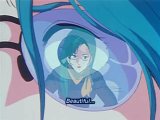
I wondered if anyone could get an overview of anime without ever seeing it. My conclusion was simply no, and you'd have to watch a fair amount to get a good idea of what it's really about. With that in mind, I thought a visual sampling of anime might help, just to see what it looks like. Much if not MOST anime is available dubbed in the English. My preference is Japanese with English subtitles which the samples reflect. Keep in mind it's hard to get much drama or comedy in short clips, so sample content is pretty limited.
Collecting a sampling of topics over a range of decades became an interesting project for me. I won't say I did a great job encoding them, but this isn't a website with unlimited bandwidth, so I sacrificed some quality to keep the size down.

Captain Harlock (1978)
Released by Discotek
|
Macross (1982)
Released by Animeigo
|
Blade of Kamui (1985)
Released by Animeigo
|
Magic Users Club (1996)
Released by Bandai
|

Vampire Hunter D (2001)
Released by Urban Vision
|
Beat Angel Escalayer (2004)
Released by Kitty Media
|
Initial-D (2005)
Released by Funimation
|

School Rumble (2006)
Released by Funimation
|
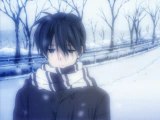
Clannad (2007)
Released by Funimation
|